Showing posts with label Iceland. Show all posts

Tuesday, July 26, 2011

Iceland Chronicles - Afternotes

So what did we experience the last two weeks"

  • 1 Geyser (which was not the actual geysir but a fake one a little on the side)1-2 Minke whales
  • 2 white tailed eagles (do you see those little white dots on the rock? no! well those are eagles)
  • 4 boat round trips (one on an amphibian vehicle)
  • few glaciers
  • ~2860 km of roads (thats a bit more than 200 km per day)
  • ~64.8 hrs of driving according to the car's computer (and thats a bit more than 4.5 hrs of driving per day)
  • hundreds of waterfalls
  • 6033 Camera clicks (about 430 per day, or one every 3.3 min on average)
  • Millions of sheep, horses, puffins, and seabirds, and also some cows.
  • Very few people (outside of Reykjavik)

Some lessons about Iceland

Roads:

The roads in Iceland are usually two lane roads. Most of the drive they were paved, with a center separator line. If they were in real good condition they also had margin lines. We did drive quite a few gravel roads, which usually were in reasonable shape. Although, we did experience few really annoying ones. These rattled every part of the RV and sometimes it felt that our teeth are getting loose.

The roads are almost always elevated. This is probably due to the large amount of water in the winter. This, however, means that there are no margins to pull over to. There are parking spots every once in a while, but it took us a while to get used to the fact that we can just stop on the road if something really interesting was happening (as long as we were visible for afar.

Unlike the popular myth, there are many roads aside from the #1 ring road. However, the ring road was a dominant feature in our trip.

Some of the gravel roads were single lane. This means that you have to make sure to see if a car is coming the opposite direction. In such a situation one of the cars pulls off to side, either on the road if it is slightly wider than a single lane, or if it is narrow, there are special bays (marked by a big M) alternating on the side of the road.

Similarly, most bridges (and there are many) are single lane. Again, the right of way is not pre-defined, but rather first come first go. Most of the time it was not an issue as we came to the bridge with clear view of empty road on the other side.

Outside the Reykjavik area, we didn't see real traffic. We never felt totally alone on the roads, but cars were far apart.

Orientation:

We found navigation pretty easy. The signs on the road were clear and helpful. All points of interest were marked by signs on the road, so we never were in a situation where we missed an place. The maps in the books were usually sufficient to navigate on our trip (I guess going on the rougher inland roads requires better maps).

People at Tourist Information desks were very useful and nice. Many places had "Information" signs that provided the main information one might need (map of the area, location of services (hotels/restaurants/camps/gas stations) and attractions.

Guides:
We had two guides. The roughtraveler and the globetrotter. We never used either series before. The rough traveler was more informative and provided site by site story on every possible stopping point on the way. This was nice, and often useful. However, it was also hard to distinguish worthwhile stops from all the rest. The Globetrotter was the opposite. It was conciser and had star ranking for every place. I don't necessarily agree with the ranking, but it gave a sense of where the points of interest that we should consider are.

Camping grounds:

The camps we stayed in fall into two main categories. The ones in the obvious places in national parks or major cities. The others were from a printout of a list of campgrounds that we found in the car (it was not clear if the rental company left it, or some previous travelers). This list ranked campgrounds by a star system and also had detailed list of facilities in each. These were often off the main road or somewhere between cities.

In general, we never had problem finding a place to camp (except one situation I described in an earlier entry). Most of the camps were reasonably good. Few issues. First, the showers were not always as good as one might expect. Some campgrounds had coin operated showers, which were surprisingly good. Others had "free" showers. The differences were usually due to the state of the facility, the amount of hot water, and also the number of showers. For example, in Hofn, there were three showers in a camp with several hundred visitors.

Most camp grounds did not have "private" areas. But some had lines of young trees separating different plots, and so there was some sense of isolation. We usually did not have our own table+benches. However, many camps had central kitchens where you could cook and also sit and eat. In the cities this area was often too busy to use. Since we had an RV we usually ended eating inside.

Costs & Stores:

Everything in Iceland is expensive. Very quickly we stopped converting to avoid being shocked at the prices. A stay in a camp can cost around 1000 ISK /person and 500-800 ISK for electricity.

In some places teens were half prices, and in many they were free (the fact that Lior was 15 got her free tickets in many museums and attractions and in few places Roy who was under 18 also counted as youth).

The selection in stores in Iceland was limited compared to what we know. For example, we never found parmesan cheese, a common stable in many places. However, we never felt that we didn't have anything to eat. The vegetables (as well as most of the other food items) were all imported and pricy. There were few supermarket chains that we found almost in every large town. In every gas station there was a small market with essentials. Basically, we didn't feel that we would be out of food, although we did stock up initially.

There were several icelandic cloth brands (the most heavily advertised is 66 North) which seem to be well made, but very expensive. As you might expect, the production of few items I checked was actually in the far east...

Monday, July 25, 2011

Iceland Chronicles - Part XIV (Þingvellir and Blue Lagoon)

After the magnificent afternoon and evening yesterday, it was disappointing to wake up to the sound of rain. The sky was cloudy and dark. We braved the elements and went out to explore Pingviller. Immediately after we set out the sun came out and it was warm and so we packed the raincoats in the backpack and continued.


Þingvellir (pronounced Thingvellir) is on a large valley created by the separation of the atlantic and american tectonic plates. The whole region is characterized by deep crevices caused by the work of these forces.

Against one of the bigger crevices is the area where the Icelandic chieftains had a yearly meeting where disputes were resolved, laws were agreed upon, and other social activities took place. This is also where the Icelandic Republic was officially declared in 1944 when they revoked the reign of the Danish King over them.

We started by walking to a waterfall of a small river that flows into the big crevice.


Then we continued to a pool formed when the river leaves the crevice onto the lower plain. The pool is known as the "drowning pool" for one of its uses in medieval times.


After a stop to overlook the plain, we continued along the river.


Many geese were lurking in the grass and didn't seem to mind human presence so close to them.


Going back on the other side of the river we passed a small church, which mark the location of one of the first churches in Iceland following the conversion to christianity. We then to some of the smaller crevices. They are filled by water from underground springs, and are famous for the clarity of the water inside.


After Þingvellir, we stopped for a soft icecream, and then drove back toward the coast. As we got closer to the coast the wind and rain intensified, and we were in a very nasty storm. We drove to the Blue Lagoon - a famous man-made pool of hot mineral water, which is considered a must see and one of the best SPA's in the world. Since it is very close to the airport, we planned to spend some time there and then return the car.

The way to the Lagoon was in extremely bad wind, and it was hard to keep the RV on track. The Lagoon sits in a large Lava Field with ragged looks. Getting from the parking lot to the main building required walking through a path between two walls of frozen lava. The wind was blowing into our face and it was quite an ordeal.


Once inside, we decided to be brave and take the plunge. The way to the dressing room as confusing. Although the whole design is very nice and functional, but very confusing to first time visitors. Given that it is a tourist destination, this is odd.

After switching to bathing suits and bathing, we had to go out of the building and into the pool. This was again a dash against the harsh wind but this time half naked. Once reaching the pool things improved.
The water was quite warm but not too warm, and with a striking blue-white colors. Aparently the hot springs pick up some minerals that give it the color. All the rocks around the pool were coated with white plaster like, which I guess was deposited by the water.


It turns out that in several points there are inlets where hotter water is injected every few minutes. This causes much hotter streams in the water. We tried to find the place where this was most often. Above the water the rain was mixed with hail and seemed to come at us almost horizontally.

After a bit more than half and hour we decided we had enough. Again we need to build the courage to run from the water into the building. Once inside, a hot shower was reviving.

We dressed and decided to move on. The way back to the car sufficed to get us half soaked.

We drove to Keflevik (the airport town) 20km away. We found a gas station with a car washing stand, and in pouring rain, I washed the car. In a country where water is abundant, the wash was with a long broom like hose that sprays water at high pressure while scrubbing the car. Standing downwind from the spray was deadly, but since the wind was shifting, I got splashed few times.

We then packed all our belonging, and had time to get dinner at a cheap american diner.

Getting to the airport we were pelted by heavy rain. It seemed like the whole sky is raging against us. Inside, we found a small but very nicely organized airport. When the time came, we walked from the waiting area (with all the dutyfree shops) to the gate area. Our flight was at Gate 10. However, there was no gate there. It took a while to realize that Gate 10 was a bunch of stairs leading down between Gates 9 and 11. To add to the confusion, Gate 9 was also a flight to Vienna, scheduled 5 minutes before ours by a different airline. We were told to wait upstairs and the whole corridor was crammed with people waiting for these two flights (while the rest of the airport was deserted).

It turned out that our gate was not a sleeve to the airplane (like the others) but rather a staircase leading to a door from which we walked to the airplane. And so we found ourselves running in the pelting rain on the tarmac to the plane. We, and many other passengers, already checked in our rain jackets and so it was an unpleasant departure at the end of a vacation.

And Thus Ends the Iceland Chronicles of the Friedman Family

Iceland Chronicles - Part XIII (Reykjavik)

Today was dedicated to exploration of the capital city. After breakfast we debated how to best view the city. The campsite is about 2km from the main city center and the route to/from the heart of the city seemed rather dull (just neighborhoods). In the camp office we saw a brochure for a Hop On/Hop Off tour bus with explanation. We had good experience with such buses in other cities, for example London and Barcelona, and thought this was a bit expensive (20Euro /person) but could provide some explanations and show us sites we would not reach otherwise. The brochure said the ticket was good for 24hrs, which sounded promising.

Then we discovered that the bus leaves only on the hour. This meant we had to wait 50 minutes (as we just missed it), oh well. At the due time we waited at the bus station and it showed on time.


The driver was very nice and sold us tickets, we took headsets and headed to the second floor. The bus was quite empty except us and an elderly couple. After two stations, we got off at the Hallsgrimskrikja - the large cathedral of Reykjavik.


Inside the cathedral was stark in its line and lack of decoration. One whole wall was dominated by the huge organ which was playing (not sure if it was on a recorded keystroke mode or live, I suspect the former). It definitely had very impressive sound.


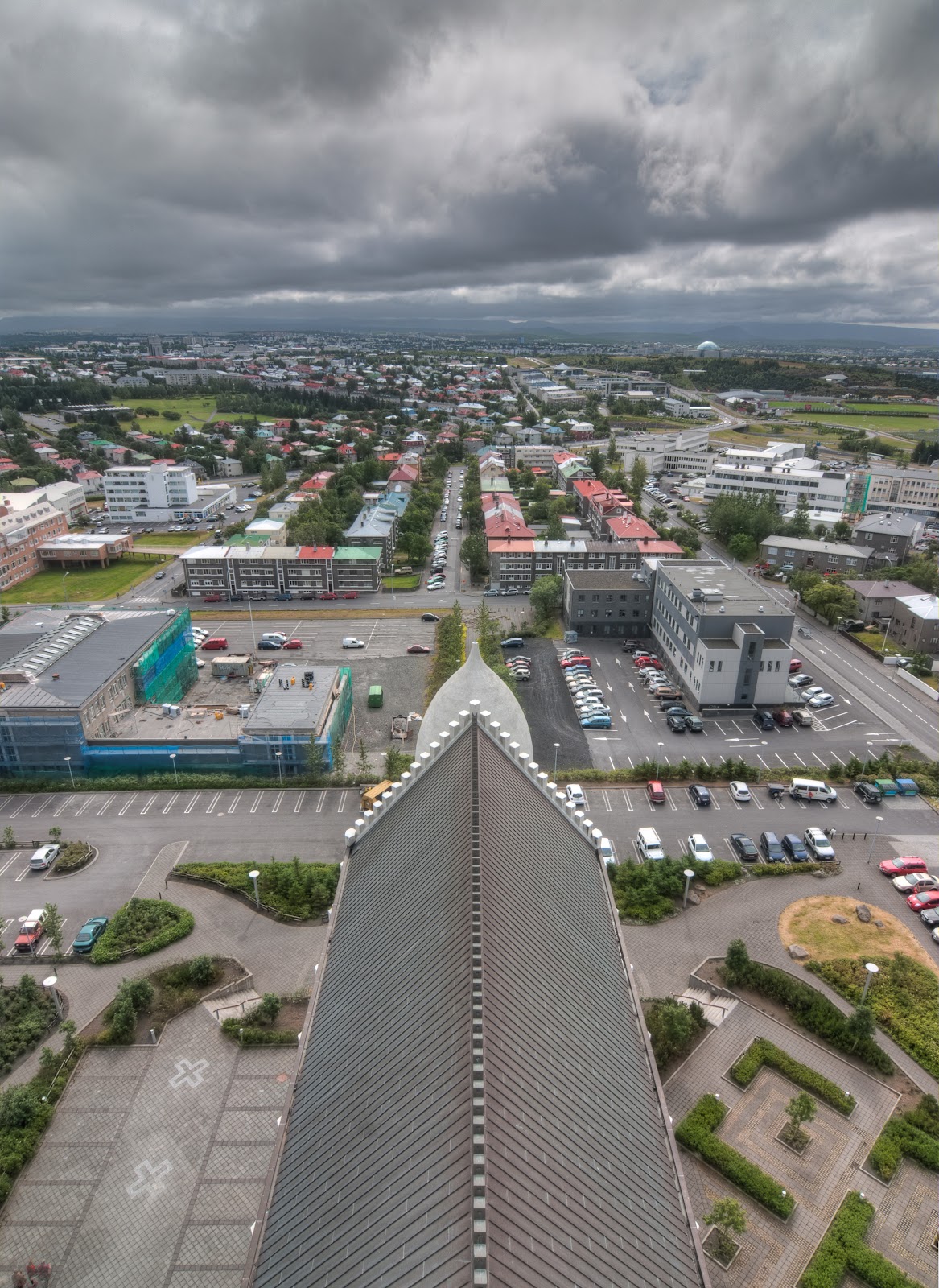
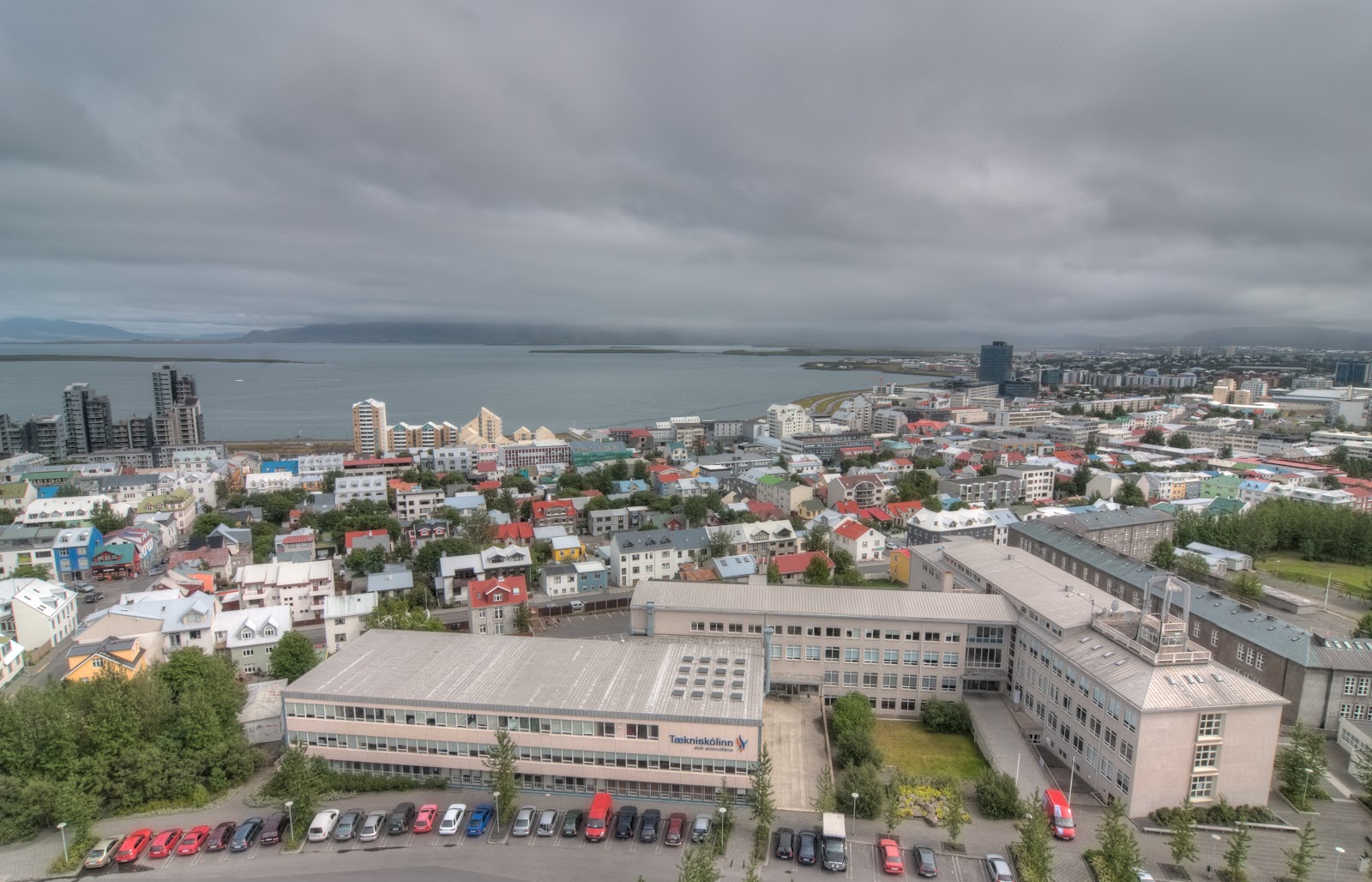
We bought tickets for the elevator and went up to the cathedral's tower, which is about 9 stories high (we went up 8 floors by elevators, and the last level by wooden staircase. From above we saw the whole city and the mountains around it.


From the cathedral we continued on the street leading to the old town. The street was lined with small shops and we spent time examining jewlery stores, bookstores, and even had ice cream.


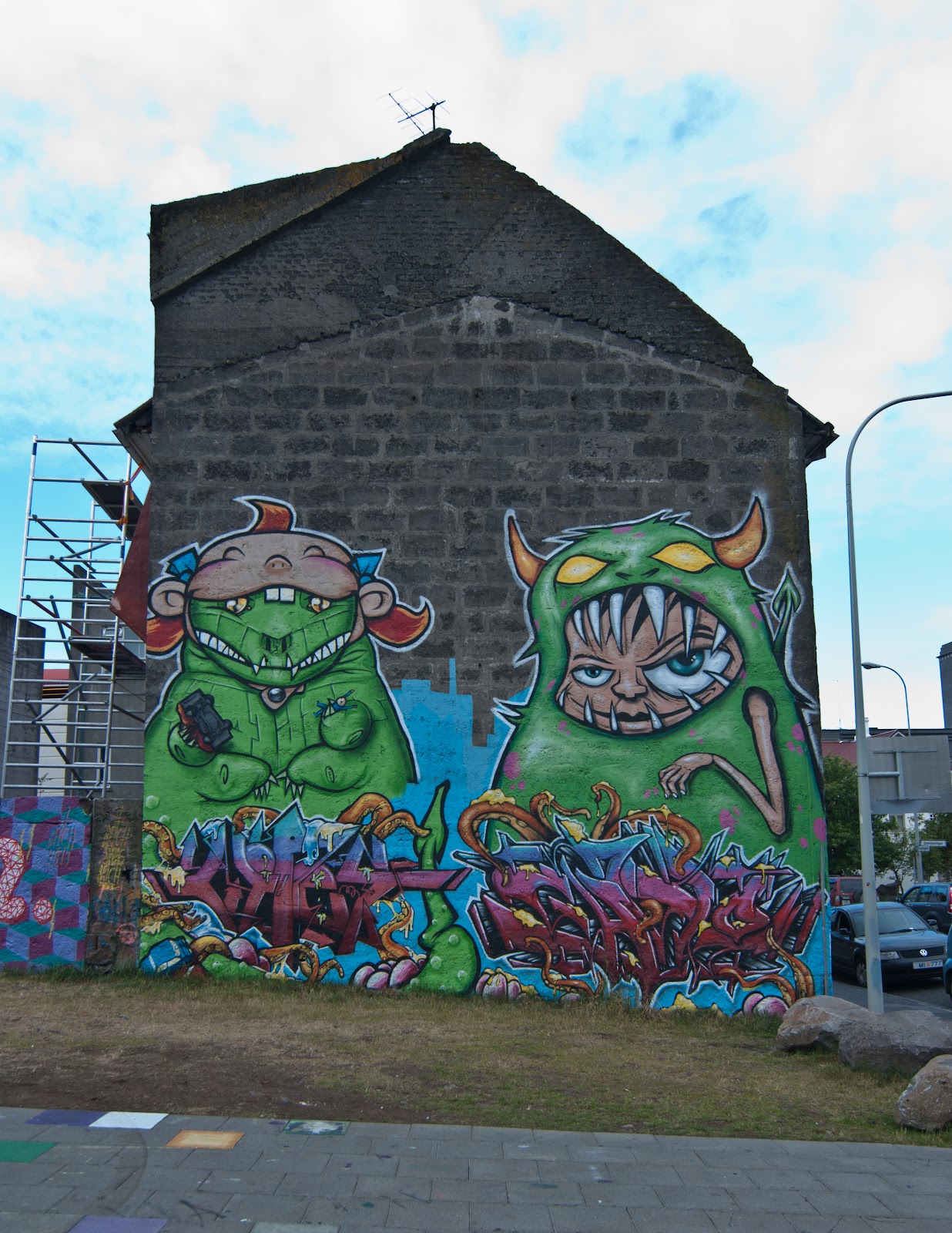
Off one of the main shopping streets we found an open space that we decorated from all directions by impressive graffiti. It was unclear whether this was semi-organized somehow (choosing the artists etc).


We walked down to the waterfront. There is a nice walkway along it. We reached a sculpture that iconify Reykjavik in many pictures. It symbolizes a viking ship. We stopped here for a snack and to enjoy the view.


About a hundred meters from the sculpture stands a new conference hall/orchestra house. 


Workers were still putting on the final touches on inside details.


Inside the fractal texture of the outside was maintained in the ceiling of the inner space.


We didn't like the architecture, but it was clearly striking. Outside there were decks and pools. While they did not finish the construction, the local seagulls already use them to bath themselves.


We were now in the center of town, very close to the area we were in yesterday. We changed some cash to ISK, and saw a demonstration against whale hunting.


We walked to the 871+/-2 museum. This is a site of old viking houses that was discovered by mistake during works on the foundations of a new building. They history records (which are somewhat in doubt) state that there was a farmstead in this area at the time, but it was surprising how accurate the location was (since the site is just next door to where the original farm of the first settlers in Iceland was supposed to be located.


The name of the museum reflects the finding that one of the smaller remains was below a layer of ash that dates to a volcanic eruption in 871. This dates that building to pre-871, which means very early in the settlement of Iceland. The bigger house is from about hundred years later.


Although there was little to see in the actual remains (as most of what is left is the mark of where the wall foundation stood), the museum was very tastefully done and gave a good perspective on what the place and life looked like at that time.


We were thinking of moving on from the old town. But again we missed the hour of the bus. And so we decided to have something to eat -- pizza and fish & chips. The sun came out, and so we sat on the sidewalk and enjoyed the sun. When the hour was close, we walked to the bus station and waited for it. When it didn't arrive, we looked again, and saw that in small print it states that the bus comes on the hour between 10-16. Since it was 17;00 already, we were waiting for naught. We found it highly misleading that the brochure said that the ticket is valid for 24hrs, but the bus works only 7 hours. No wonder this service was not very popular.

We walked to the tourist information center to complain. They said they are not responsible, but talked on the phone with the responsible company (which runs all kinds of bus services), then they agreed to refund us if we show up there. And so we walked to the bus terminal (about 20 min walk).


At the bus terminal we got full refund and apology. We took a taxi to the campground, and on the way we decided that we had enough of the city. We packed ourselves and drove out to Pingvellir - the third Golden circle site we missed yesterday. Here the campground was empty, cheaper, and the view much nicer.


Sunday, July 24, 2011

Iceland Chronicles - Part XII (Golden Circle)

We went to sleep last night around midnight, with partially clouded sky. Sometime during the night we were woken by rain on our roof. Now is the time to say that yesterday evening we used the camps laundry machine to wash our cloths. After the was over we discovered that the dryer was broken. Thus, we borrowed cloth-clips (what is the term for these?) from the camp owners, and hung our laundry to dry in the wind outside the RV. Yael was quick and rushed out of bed and got all the cloths into the RV when the rain started.

When we woke up it was raining hard and seemed as though we will have to swim out of our position in the middle of the campground field. We debated what to do with all the wet laundry and the wet towels from yesterday's shower. We ended using the two ladders as drying racks, which we put next to the RV heater (which we barely used). We turned it on to full setting and opened all the windows. This was not necessarily energy efficient but it seemed to do the trick and most of the cloths dried while we had breakfast.

We got on the road aiming for three attraction that are "dubbed" as the "Golden Circle" as they are often done as a single day-tour out of Reykjavik. Since we came from the east, our route was not a circle.
We drove west with the base mountain Katla, the volcanic "bad boy" of Iceland that recently erupted, appearing below the clouds. We had to get off the ring road to drive through a large plain that is full of green hills and farms. At the northern end of the valley we reached the Geysir site. This is a small plot of land where bubbling water climb to surface.


Here is the site of the original geyser, whose name was Geysir, and thus the origin of the term.
Geysir stopped blowing some time ago after an earth quake, but next to it was another active geyser that blew off every 8 minutes or so.


We watched several cycles. Initially, you see a pool of bubbling water that seem to go through gentle tides at very low rhythm. Then, one of the tides keep flowing up and a blueish bubble forms on the surface of the pool. The bubble bursts and suddenly a huge flow of steam shoots up.


The area of the geysers (active one and many inactive pools) was surprisingly small considering it is one of Iceland's highlights. The visitor center/food court/souvenir shop next to it was much bigger than the actual attraction.


As we came back to the car it started raining again. And so we stopped for a quick noon time meal waiting for the rain to ease up. The rain however got stronger and stronger. After half and hour break, we decided to continue to the next stop at Gullfoss - the Golden Waterfall.


This is an impressive two stage waterfall of a large river. Something of the local version of the Niagara Falls. Outside wind was blowing and it was raining. And so the troop was unwilling to venture out. I braved the elements and went for a round with the camera inside a plastic bag.

The path down to the falls was wide and not too slippery (considering the hard rain). Up close the thunder of the falls was impressive. It was possible to walk almost to the water which gave proportion of the sight.


After Gullfoss, we decided to skip the third attraction of the Golden Circle and head into Reykjavik. It was sunday evening and so the downtown area was mostly empty. We parked next to a big pool that houses many water birds. People came out here to feed the ducks and seagulls with leftover bread.
This led to flurry of speedy seagulls trying to catch the bread before it hit the water.


Next to the pool stands the town hall in a nice structure. We walked toward the sea, and came to street with tourists and few tourist restaurants. After some hesitation we went into a cosy place called the Laundromat. It did have few laundry machines in the basement, but the main hall was tables were people were eating, reading, browsing the network, and chatting.


We had a nice meal and played a bit with photography.


After dinner we drove to the city campground, which is sitting next to the pool (as it turns out is the custom in many Icelandic towns). It was a bit crowded but otherwise fine.