Wednesday, September 5, 2012

Greece sailing, day 2 - sailing to Poros


I woke up with light coming in through the small windows. Everyone was a sleep and so I climbed outside to see the sun rise beyond Ithaca. Ayelet, who is also an early bird, woke up and we sat on the deck drinking cappuccino. (The boat is equipped with a small makineta and a cool device for frothing milk.)
Sunrise

In preparation for the day I checked the diving equipment drying on the boat's upper area and realized that I am missing a light (torch) that I gave Tomer during the dive (see picture in yesterday's entry). Apparently, he clipped it on his jacket and we forgot to take it off when we returned Tomer's rented equipment.

After a quick check with Udi, we decided to do the half hour trip back to Fiskardo. And since we will be there, to get breakfast over there. We raised anchor and started on our way back.

When arriving in Fiskardo harbor again, Udi decided to skip mooring. Instead, Ayelet and me took the dingy to shore while Udi idled in mid-harbor. Since Udi let us off about twenty meters from the quay, we didn't bother using the engine and I practiced rowing instead. We tied the dingy to the quay and went looking for Takis. We saw his boat, but he wasn't in. We asked the waitress in the cafe next to his boat whether he was in, and we were told he probably went to fetch something and will be back in "5 minutes". By now I learned that this can be a rather variable unit of time. To make use of the wait, we strolled to the bakery to buy bread. We decided that the tiropita at the bakery didn't look as good as the store we bought from yesterday, and so proceeded back to that store. On our way we run into Takis who was surprised to see us again. He said he didn't see the missing light, but will check. He had small business at the post office and will be back in his boat in "10 minutes" (more worrisome). We bought tiropita, spinakopita, and olive pita. After a short wait Takis showed up, and quickly found the light clipped on the jacket. We said goodbye and returned to the dingy and with it and all our goods back to the boat.

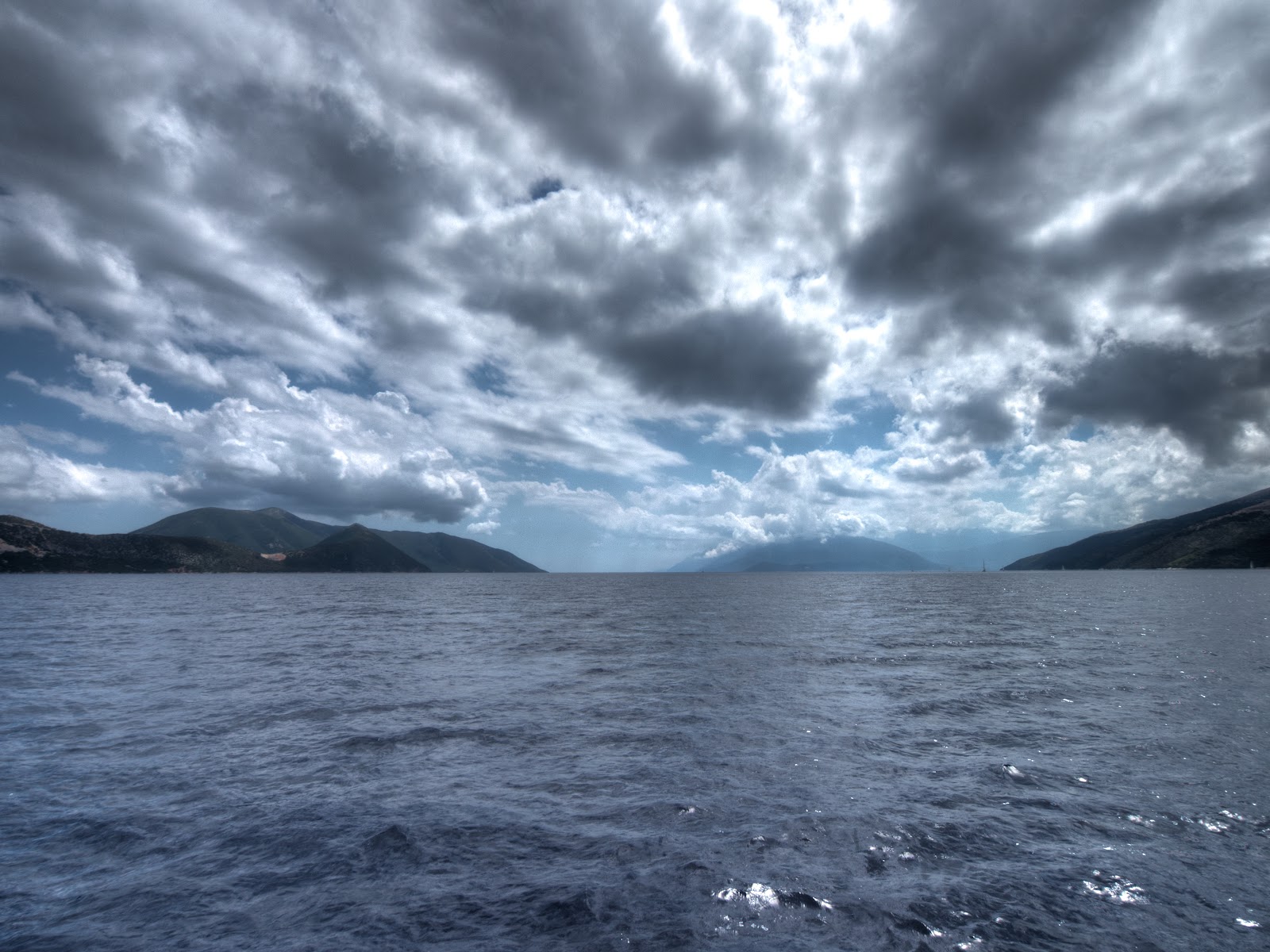
We started sailing south along the channel separating Kefallonia and Ithaca.


An important part of the sailing routine was to drop a fishing line behind the boat. At the end of the line was a fishlike plastic bait with hooks. The idea is that predatory fish believe the bait to be a small fish and try to eat it. By now I heard story about the success of different baits, and that one kind managed to bring in few large tunas. On the way to Kefallonia this bait caught a big swordfish. After a heroic struggle Udi brought to the boat, but the at the last minute the fish managed to sever the line and escape, with the bait. The loss of a tasty dinner (several actually) was a disappointment. Moreover, we were now forced to use an inferior bait.

To our surprise, fairly soon after leaving Fiskardo port, the line showed some movement. Udi suspected we managed to hook some floating debris or seaweed. Reeling in the line, It was quickly apparent that we caught a fish. It was silvery and looked fast, and it's fins were reminiscent of a tuna, but it was much smaller. We later learned from a local fisherman that it was a palamida, which is rather unclear name to subgenus of Mackerels (called Scomberomorus in scientific classifications). I suspect that most likely it is an Atlantic Chub Mackerel but as usual with fish, classification is not easy.

The catch
Catching the fish is only the first step. Next, one has to kill it somehow. The traditional approach is rather brutal, and I will spare the details but will mention that it involves a club. Ayelet learned that spraying ethanol on the gills kills fishes quickly and more humanely. And so while Udi was lifting the fish she attacked it with a 70% percent ethanol spray bottle (that looked suspiciously familiar). Once the spray actually reached the gills the fish subsided rather gracefully and the experiment was declared successful. Ayelet also heard from her sources that hanging the fish upside down removed some of the blood from the fleshy parts. And so we took a small piece of rope and hanged the fish from its tail outside the deck area.

Trying the Ethanol treatment

We reached our first destination for the day, a small island in the middle of the channel that was barren except for a small church. According to nautical map there was a nearby wreck in shallow water. The reflection of light made it hard to spot the wreck. Udi brought us to the marked location on the map, and I jumped to look for the wreck. Since this was an impromptu search I took only snorkel and mask and left my fins (and camera) on board.

Small island and a church

The water was a bit dark, but I could see the seagrass growing on the bottom. I started to widen the search and started seeing shapes underwater. Getting closer these turned out to be flat slates of rock. The diagonally layered rock here was eroded and left a series of tilted slabs on the bottom. While exploring these I encountered a group of snorkelers. I asked one (who turned out to be the guide) where is the wreck. He answered that there is no wreck about. I started swimming toward our boat, which seemed far away by now. Swimming without fins was surprisingly slow, but I finally made it.

I learned that while I was searching for the wreck, Ayelet took her mask and fin and also searched for the wreck. We started looking for her. Since there was another group in the water we could not distinguish her from the rest, and so we slowly moved over to their position. We still could not find her. In the mean time the group started returning to their boat, and after few minutes the water was clear of snorkelers. Still no sign of Ayelet. At this point we got a bit too close to rocks near the islands and Udi had to back up to avoid running into them.

At this point we got a bit worried. The snorkelers boat left the area and we were alone in the water. Suddenly we spotted movement on the far part of the island. Upon getting closer, we indeed found Ayelet. She decided she will find the wreck no matter what and ended up circling the island, including parts with strong currents.

We resumed our course southward. Slowly the wind picked up, and the captain decided to open sails. Once the sails were open and full, we turned off the engine. When sailing the boat sounds very different, the noise of the engine is gone, and instead there is the occasional slap of the sails.

By now everyone woke up, as well as our appetite and we decided that breakfast is due.

Late breakfast

After breakfast we set out to the task of cleaning and filleting the fish. I volunteered to show my skills in filleting (which was mostly theoretical). Between Udi and me we managed to clean, fillet and skin the fish in nice cube sized chunks. Roni, the cooking enthusiast aboard took over from here and marinated the fish in olive oil and lemon juice with some fresh herbs thrown in. (The boat was equipped with a basil and mint plants growing under the spill shield above the cockpit.)

Surprisingly, travel takes time. And once on our course there was little to do fo few hours. There are many ways to spend this time differently, chatting, reading, or napping. After we passed reach the bay of Samis, Udi went sleep while Ayelet was already napping on the deck. I was left in charge.


The southern tip of Ithaca

This sounds very serious. In fact it was relatively simple. The boat has auto-pilot that can maintain a given direction. It counters the shifts due to waves and wind. The person in charge has to watch out for other boats to avoid collisions. This can be hard in busy areas with a lot of large commercial ships (that move very fast compared to a sail boat). In calm water this was less of an issue.

This a good time to mention some of the devices on the boat. For sailing, an important device is a wind meter that reports the strength of the wind and it's direction relative to the boat. Watching this meter ensure that the we face the risk of the sail flipping sides in uncontrolled manner. Another important device is the bottom meter that measures the depth of water below the boats keel. This is particularly important when navigating close to shore.

The most recent addition to these devices is the combination of GPS with an iPad. The boat iPad has an application with detailed nautical map, and it shows the position of the boat and it's trajectory. In addition the iPad is interfaced to a system that serves to share positional information between vessels on the water. Each boat or ship broadcasts it identity and current position and trajectory. This information is displayed on the map to avoid potential collisions. An elegant feature of this system is that each vessel transmit not only its own position, but also all the information it has on sea traffic. This means that a small sailboat can get a map with ships that are still beyond its reception range.

The upshot was that navigation was looking up the desired location on the map and drawing a line toward it to get the orientation one has to guide the boat. Then setting the autopilot to keep that direction and hang back. Once every few minutes a glace to see that the water ahead is clear suffices to avoid troubles.


After rather quiet sailing south we reached the Poros area. The mountains on the island reach the shore with very steep slopes creating a dramatic effect. Poros itself is situated at the outlet of a small stream that over the years dug a gorge through the mountains.


Poros gorge
Anchorman is ready for action

The landing at the harbor was smooth. Ayelet was at the helm and got very good grade from the captain on her performance. The port itself is a bit separate from the main town, but has few stores and tavernas catering to the port visitors and for people waiting for the ferry that reaches the port several times a day.
Island-hoping tourist "pirate" ferry

Ayelet decided that the boat need a wash. Since there was free water here, this was a good spot to do so. What started as washing the outer deck, ended as a through scrab of all the surfaces.


We were recruited for various tasks through the cleanup, but most of the effort was Ayelet's. When she finished the boat was glowing white and smelled of fresh bleach.

twilight time

last rays of light
the scrub must go on


Tonight, Roni took charge of dinner. She decided to go for a greek recipe (from an Israeli cookbook) of rice and spinach. She and Udi went to the store to get the required ingredients, and then she set off to work.
Roni at work in the kitchen

Tomer and Udi spending time before dinner

Between Roni and Ayelet's cleanup, we ate very late. The food included a salad, ceviche (from the fish we caught earlier), spinach rice, and grilled sausages. 

Large ferry boat
By the time we finished eating it was almost midnight and we were all very tired. Moreover, we had to start early tomorrow for our trip. 


Tuesday, September 4, 2012

Greece sailing, day 1 - getting wet

I woke up relatively early, and found Ayelet up and about. She suggested we search for a cafe to enjoy coffee while everyone else slumbers. Most places were closed at the wearily hour of 8am, but we a nice place that just opened and sat down next to the water. Although it was in the harbor, the water was clear and we could see the small fish darting here and ther in the water.

The Ester, moored in Fiskardo

Afterwards we went to check the area and look for local diving clubs. 

View of Fiskardo bay

In the first one we found a nice French guy that told us about the diving options around Fiskardo. The club however did not rent equipment and only had group dives. We did get to photograph a map of the recommended dive site.

Dive site map

We continued to the second club, which was a small booth along the promenade. It turned that the club itself was on a boat that was moored nearby. We talked with the divemaster who gave us prices for rental. These seemed rather high, but he gave us a whole speech on the greek tax burden and how the club sees 4 euros out of 10 we paid. We said we will think about it, and he suggested that the price for a private guided dive will not be much higher than rental. We went back to the boat to consult with Udi, and decided to go for one dive. We returned to the divemaster and said we will go for a guided dive. He said that he wil, be free in the afternoon. We set a time for 4pm. His name was Takis, and he recommended places to buy breakfast food.

We went into a restaurant Takis recommended and indeed they had nice baked good. We bought some tiropita, cheese pie, and spinakipita, spinach pie. Both are very reminiscent of Bulgarian pies that my grandmother used to make.

We returned to the boat. The plan was to sail for few hours and then return In the afternoon when Ayelet, Tomer, and I will dive, and Udi and Roni will fill the water tank and rest.

Exit from Fiskardo harbor

Leaving the port I learned form Tomer how to operate the anchor. We slowly exited the harbor toward the eastern passage between Kefallonia and Ithaca. We headed north toward the tip of the island. Once the course was set, we sat down for breakfast.

Roni and breakfast table

We sailed around the north shore of the Fiskardo peninsula. The northwest corner has high cliffs that faced the elements and from afar we saw structures that looked like caves. We anchored the boat.

Fiskardo area, courtesy of Google Maps

This was the first time I saw the procedure. Basically the idea is to release the anchor while the boat is moving backward. The release is by an engine that unwinds the anchor chain. Usually the captain asks to release about 10 meters more than the depth. This allows for a diagonal anchor chain which avoids the boat scraping on the chains. Once the request chain length is release the captain continues to reverse the boat until it is clear that the anchor is secured on the bottom (in Hebrew the term is "pinned", I am not sure what is the proper English term).


I'm our case this was done smoothly without issues. We donned swimsuits and snorkeled and jumped to the water. The first observation was the clarity of the water. The sound directly above created a ray-like effect that I found mesmerizing. We swam around the rocky shore and watched the rock structures both above and below water. Tomer turned out to be an ideal companion for snorkeling and a great model.


Water level view of Ester

After a while we tired of this and sawmill back to the boat. After rest and rehydration, we decided to explore the cliffs to the south of us. Tomer, Ayelet and me went on the dingy (small inflatable boat). This time I took my fins, as I discovered that swimming with a camera is very inefficient. Going along below the cliffs we saw a large diversity of shapes and colors. 


 At some point we discovered a small cave, and further along, a larger one that we could enter with the dingy. The plan was to tie the dingy to a rock. However the attempts to do that resulted in a messy failure. So we decided to take turns on the dingy.


The caves are vertical structures that start high on the cliff edge and continue underwater to the bottom about 10 meters or so below. The water color inside the caves was a special fluorescent blue and provided dramatic images.


At this point Ayelet decided that staying on the dingy was boring and so she continued snorkeling with the dingy in toe held by its rope. We continued along the cliffs back in the direction of the boat.


When we tired we boarded the dingy and Tomer took us to the boat. By then Udi raised the anchor and came looking for us. We boarded, tied the dingy and we started sailing back toward Fiskardo.

Upon arrival to the harbor our aim was to find a mooring berth along the side where there was water and electricity so we could fill the water tanks. I learned that yesterday's mooring space was a less favorable since all the good positions were taken. On entering the harbor it seemed that once again this the case. Udi, however, said that we can squeeze in. An important lesson is that parked boats are not as immovable as parked cars for example. While the boat was moving backward into the intended spot Tomer and I pushed the boats on our two sides and created space. It was tight but worked like a charm.

After a small meal we hooked with Takis. We sat down for cold coffee and Ayelet talked with him about the current situation. It turns out he had two shops in Athens (diving and yacht supplies) and and had to close them when the crisis came in. He gave us examples and talked many people's income dropped to less than a fourth of what it was in parallel to tax increases. This is beside the growing unemployment. Overall, he painted a rather bleak view of current Greece life. According to him, ,many people have nostalgic sentiment to the pre-euro days.

We then moved to Takis' boat and Tomer got equipped while Ayelet and I set up our own equipment. Takis took us on a his speed boat out to the dive site. This was more less the trip we did earlier, but now it went by much faster. The dive site is on the northern most tip of the island. There is a cliff that angles into the sea and continues underwater. There caves on the "cliff side" that allow passage from the top to the cliff bottom. Since Tomer is a junior diver, he could not go all the way and he and Takis took a tour above the cliff.

Sea star

Cave

Tomer checking the colorful walls

Cave, diver, and sea star

A colorful worm

Ship wreck

Ship anchor

Takis and Tomer

Afternoon light

From the caves we continued to a wreck that was situated around the corner. My air was running low, and so we started angling toward our entry point. We returned as happy crowd to the port. Takis unloaded our equipment on the pier next to our boat, and we washed it and loaded onto the deck for drying. We invited Takis for tea, and sat down to chat. This took a while and it was getting late. While we were gone Udi refilled the water supplies and did some shopping so we were ready to go.


Roni on the helm
The plan was to moore in a bay south of Fiskardo. There was one that looked like a natural harbor on the map, but it was already occupied by three boats. We decided to continue south to a bay that was shallow but long. We got there and found that it was occupied by the huge boats. And so we ended in the next bay which was small but relatively deep, suggesting it will shelter us.


By then it was already twilight and the light was fading quickly. We did the anchor procedure like I learned earlier, but the anchor wouldn't hold firmly. Instead it would allow the boat to drag it on the bottom. And so we pulled the anchor back and tried again. I lost count of the number of attempts and the different strategies and locations we tried in the bay. In the end, Udi pronounced that since the weather was calm and the bay was protected, it suffices to lower a anchor with chain to sit on the bottom.

As you might imagine by this point we were a bit cranky and hungry. Luckily Roni started preparing dinner after we left Fiskardo and so relatively quickly we were sitting for dinner. By the time we cleared the dishes it was close to midnight and everyone was exhausted.

Moonrise (over Ithaca)


Monday, September 3, 2012

To sea - arrival in Kefallonia

Ayelet who run my lab and is a good fried went for an adventure with her family. They left Israel on their sailboat in April and started a trip along the eastern mediterranean: Cyprus, Turkey, Greece, Albania, Croatia, Italy, and back through Greece. Throughout this six month trip they had friends join for periods of about a week. You can read about their adventures in their blog (in hebrew).

They had an open invitation for me, but somehow things were always busy. Few weeks ago Ayelet wrote me that the trip is nearing its end and so I need to act now. We set a date for early September and I started looking for flights.

We decided that we will meet in Kefallonia (or Cephalonia, or few other variations), one of the Ionian islands on the western side of Greece. After checking ferry schedules it was clear that flying there was better. I flow to Athens and from there connected to Kefallonia. 

Take off from Tel Aviv

The second leg was in a small turboprop plane. I had a window seat, but sadly the window was next to the propellor and very dirty. And so the pictures of the takeoff from Athens or the islands are blurry.

Disembarking the plane in Kefallonia

We landed at 8 pm in a small airport. It was just after sunset. We disembarked and walked to the terminal. I collected my bag and went outside to wait for Ayelet and Udi. They arrived earlier that day in Fiskerado, a village on the northern tip of the island, while the airport was at the south-west of the island, about 60km away. They let me know in advance that they will rent a car and come pick me up. And so few minutes after I arrived they showed up in a small rental car.

The way was winded and went up and down hills that skirt the mountains in the middle of the island. At some point we saw a church all lit up on a far hillside, and saw fireworks from its yard. We stopped to ask what's the occasion, and learned that this was a test run to a large celebration that will take place on Friday night. We were warmly invited to join.


Continuing on our way we decided to stop of dinner as it was getting late. After some debates we stopped at a small taverna. The waiter was very nice and we had a nice meal with stuffed peppers, Greek salad, and platter of appetizers.

We arrived I Fiskardo. This was a relatively large yacht harbor that was jammed with boats. The water edge was packed with restaurants, and so most boats were essentially a touch away form the dinners. We found Ester, our boat, after what seemed to me quite a large number of parked boat.

I got a tour of the boat and essential functions (how to operate the restroom), i arranged my belonging in my cabin (a triangular bed, small storage, and a smallish piece of floor. we chatted a bit on the deck, and I went to sleep.